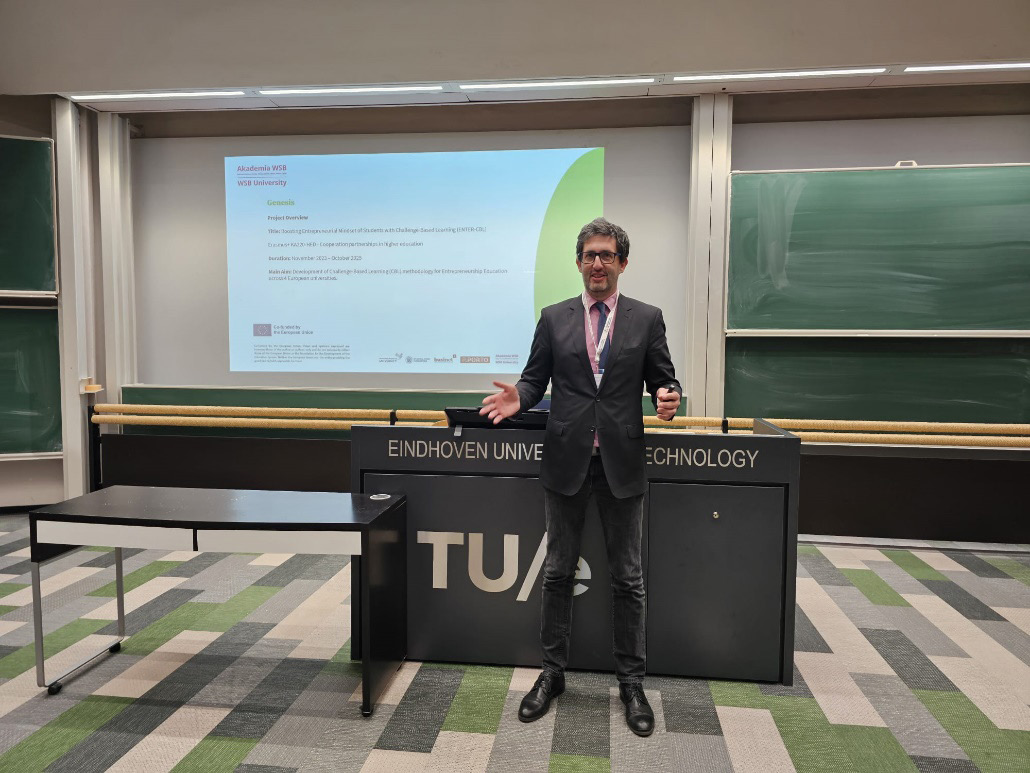
ENTER-CBL Platfrom at CBL Conference 2025 (TU/e Eindhoven) - April 2025
CBL Conference 2025 (TU/e Eindhoven): How an LMS can strengthen evaluation in entrepreneurship Challenge-Based Learning
In April 2025, the ENTER-CBL platform narrative was reinforced during the CBL Conference 2025 at Eindhoven University of Technology (TU/e). The conference programme featured the contribution “Evaluating LMS for Entrepreneurship Challenge-Based Learning Courses” within the “Evaluation of CBL activities” stream.
The presentation focused on a practical question that many educators face when moving from traditional teaching to Challenge-Based Learning: how do we design, deliver, and evaluate CBL activities in a way that is structured, scalable, and easy to manage - especially in entrepreneurship education, where teamwork, iteration, and real-world uncertainty are central?
The conference discussion highlighted that evaluation in CBL is not only about final outcomes. It is about the full learning journey: how students frame a challenge, investigate evidence, make decisions, prototype solutions, and reflect on results. To support this kind of learning, a digital environment must do more than store materials - it must help capture the process.
What an LMS changes in CBL practice
The presentation emphasized how an LMS can become the “backbone” of CBL implementation by supporting the core mechanics of CBL in entrepreneurship education:
- Structured delivery - clear learning paths, staged access to activities, and a coherent workflow aligned with Engage-Investigate-Act.
- Collaboration and communication - spaces for team coordination, discussion, and peer exchange that keep learning active and social.
- Artefact-based learning - submission of tangible outputs (briefs, evidence logs, prototypes, reflections) that document progress and make learning visible.
- Assessment and feedback loops - rubrics, formative feedback, and transparent criteria that guide teams through uncertainty and iteration.
- Evaluation and improvement - activity tracking and reporting that help educators analyse what worked, what needs adjustment, and where learners struggled.
Why this matters for entrepreneurship education
Entrepreneurship learning is often measured through presentations or business plans. The conference contribution underlined that CBL requires a broader view: evidence of learning is embedded in how students explore a problem, justify choices, test assumptions, and refine solutions. An LMS supports this by making the process traceable and easier to evaluate - without adding unnecessary complexity for teachers and learners.
For ENTER-CBL, this conference moment validated an important direction: platform-enabled CBL does not replace good teaching - it strengthens it. By combining a structured digital environment with facilitation methods, educators can deliver more consistent CBL experiences, reduce organisational friction, and use evaluation data to continuously improve entrepreneurship courses.