Partnerships
WSB Business School believes in the power of partnerships and collaborative networks as a catalyst for educational excellence and societal impact. The School actively forges and maintains partnerships across three broad areas: industry and corporate partnerships, academic and international collaborations, and memberships in professional and global networks. These partnerships are strategically pursued to enhance the relevance of our programs, provide opportunities to our students and faculty, and amplify our contribution to the global business education landscape.
Academic and International Collaborations
In an increasingly globalized educational landscape, WSB Business School is deeply committed to academic partnerships and international collaboration. These partnerships enhance our teaching and research capabilities, provide mobility opportunities, and elevate our global standing. WSB University has positioned itself as a leader in internationalization in Poland, and the Business School contributes strongly to that status through its own initiatives.
Key facets of our academic and international partnerships include
- Strategic Partnership with Politecnico di Milano (POLIMI)
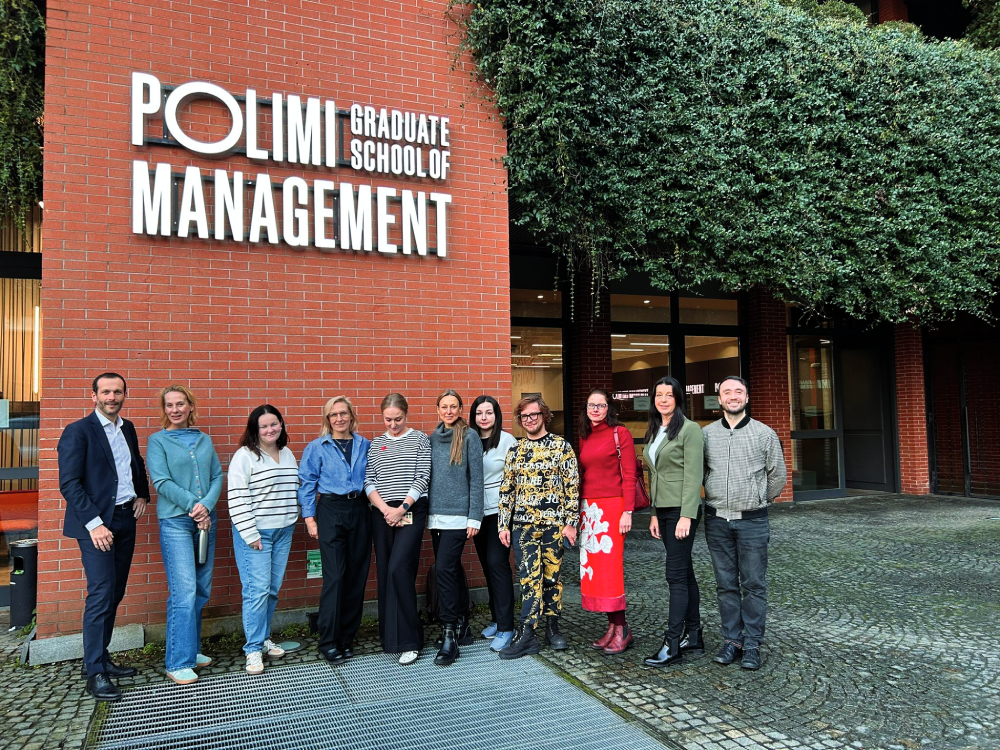
WSB Business School has established a strategic academic partnership with Politecnico di Milano, one of Europe’s leading technical universities. As part of this collaboration, a certified Executive MBA program has been co-developed, focusing on Digital Transformation and Management. The program provides participants with a high-level managerial perspective on digital innovation and change leadership. Students benefit from creative managerial workshops conducted jointly by WSB and POLIMI faculty, offering exposure to design thinking, agile strategy, and tech-enabled business models. The partnership also enables student exchange opportunities, allowing selected participants from WSB and POLIMI to spend a module at the partner institution, deepening their international and intercultural competencies. This dual-institution learning experience strengthens the global orientation of WSB’s executive education and positions our graduates for success in digitally driven organizations.
- Student Exchange Agreements
WSB University has a broad network of partner universities across Europe, Asia, and the Americas for student exchange programs. Under the Erasmus+ program and beyond, our students can study abroad for a semester or a year at over 100 partner institutions, and we welcome exchange students from those institutions to WSB. Our International Cooperation Office actively seeks to widen this network; by the end of 2025/26, we plan to sign at least 10 new exchange agreements with universities outside of our traditional Erasmus network, including in Asia and the Americas. These exchanges expose students to different academic environments and cultures, greatly enriching their educational experience. We also support and encourage short-term mobility, such as international study tours, summer programs, and virtual exchange projects (e.g., Collaborative Online International Learning – COIL – initiatives where WSB students collaborate online with peers abroad on joint assignments). - Faculty and Research Collaboration
On the academic staff side, WSB encourages faculty exchange and joint research with partner universities. We have in place agreements that facilitate visiting professorships – our faculty can spend a semester teaching or researching abroad, and we host international faculty for short-term teaching assignments at WSB. This cross-pollination of ideas benefits our students (who learn from visiting professors) and helps our faculty broaden their pedagogical and research horizons. Collaborative research projects are actively pursued; for instance, WSB researchers are part of international consortia applying for EU research grants, and we have co-authored publications with colleagues from institutions in countries like Germany, the UK, Spain, and Kazakhstan (to name a few). The School is also exploring membership in a CEE (Central and Eastern Europe) Business School Consortium for collaborative events, benchmarking, and doctoral workshops with peer institutions in the region. Such a consortium will create a formal platform for sharing best practices and possibly developing joint programs or conferences. - Global Academic Networks
WSB University (and by extension the Business School) is actively involved in international academic networks and alliances. We are participants in initiatives like the Q-Helix Alliance (a European university alliance project focused on cross-disciplinary innovation) and are signatories of accords that promote international education standards. A key commitment is our adoption of the Principles for Responsible Management Education (PRME), an initiative of the United Nations. By being a PRME signatory, WSB Business School pledges to incorporate global social responsibility and sustainability values in our teaching, research, and partnerships. We share progress with an international community of business schools working to shape ethical business leaders. This and other memberships (e.g., in the European Foundation for Management Development – EFMD – and the Central and East European Management Development Association – CEEMAN) situate WSB within the global dialogue on management education quality and innovation.
Industry and Corporate Partnerships
Strong engagement with the business community is one of the hallmarks of WSB Business School. We work closely with a wide range of industry partners – from large multinational corporations and financial institutions to agile startups and local enterprises – to bridge the gap between theory and practice. These collaborations take many forms and yield mutual benefits: our students and faculty gain insights and real-world exposure, while companies benefit from fresh ideas, research expertise, and access to talent.
Key industry partnerships strategy include
- Strategic Corporate Partnership with EY
WSB Business School has formed a strategic partnership with Ernst & Young (EY), a global leader in professional services. This collaboration supports the development of certified Executive MBA and MBA modules in the field of Financial Management and Accounting. Designed with direct input from EY practitioners, the program emphasizes real-world financial strategies, corporate governance, and international accounting standards. Students benefit from expert-led workshops, case-based learning on current industry challenges, and access to EY's thought leadership materials. The partnership ensures that participants are equipped with competencies aligned to industry demands, and it opens doors for mentoring, internships, and recruitment opportunities within EY’s network. This strategic link enhances both the academic relevance and professional impact of WSB’s finance-oriented programs.

- Curriculum Co-creation
We involve industry experts in the development and continuous updating of our curricula. Through Program Advisory Boards and formal consultations, executives and managers provide input on the skills and knowledge most in demand, ensuring our courses remain cutting-edge. For example, when designing a new specialization in Digital Marketing, we consulted with marketing professionals from leading tech firms. Similarly, our Finance curriculum is reviewed with input from banking and investment experts. This co-creation process means our graduates are workplace-ready and versed in the latest industry tools and practices. - Internships and Cooperative Education
As noted in the Career Development section, WSB has established partnerships with over 50 companies to host student interns and project teams. Major employers (including top firms in consulting, manufacturing, IT, and finance) sign cooperation agreements or MoUs with the School, committing to provide internships, mentorship, and sometimes even preferential recruitment of our graduates. In turn, the School assists these partners through student consulting projects or executive training – a symbiotic relationship that continually grows our network of collaborators. - Guest Lectures and Practitioners in Residence
Industry representatives are regularly invited to deliver guest lectures, workshops, and seminars. Each semester, dozens of practitioners – CEOs, entrepreneurs, consultants, WSB alumni in industry – come to campus (or join virtually) to share their expertise with students. We have professionals teaching specialized elective courses (for instance, a supply chain manager might teach a course on Logistics Management as an adjunct lecturer). Our planned Executive-in-Residence program will formalize this arrangement by having select industry leaders spend extended time at WSB Business School, mentoring students and collaborating with faculty on curriculum and research. - Joint Initiatives and Impact Projects
WSB Business School and its corporate partners often collaborate on projects that benefit the wider community and economy. A salient example is our participation in the Business School Impact System (BSIS) – a certification we earned that measures our impact on the local region. To gather evidence for BSIS, we worked with local employers and government bodies to document the effects of our internships, student volunteerism, and knowledge transfer on regional development. In 2026, we aim to renew this BSIS Impact certification by demonstrating even greater engagement with industry and society. Additionally, partners support or sponsor events like the annual WSB Business Innovation Awards, where student entrepreneurs can pitch ideas to a panel of industry judges, or collaborative research endeavors such as market analyses done by faculty-student teams for a company. These joint initiatives reinforce WSB’s role as an “engaged university” that works hand-in-hand with business to drive innovation and growth.
Overall, corporate partnerships at WSB Business School ensure that our education is relevant, applied, and impactful. They create a pipeline for talent development that serves both students and employers, and reinforce the School’s reputation as a source of skilled, ready-to-succeed graduates. Many of our partners attest that WSB’s collaborative approach – exemplified by initiatives like curriculum co-design and executive education for their staff – has yielded a win-win relationship. As we move toward 2030, we will continue to deepen these industry ties, using feedback and engagement to drive continuous improvement in what and how we teach.
Professional Networks and Strategic Alliances
Beyond direct company or university partnerships, WSB Business School is active in various professional networks and strategic alliances that advance our mission and credibility. Engagement in these broader networks demonstrates our commitment to meeting international standards and contributing to the advancement of management education globally.
One of the most significant aspects is our pursuit of prestigious international accreditations. As part of that journey, we have become an active member of bodies like EFMD (European Foundation for Management Development), EUA (European University Association) and CEEMAN. Membership in these organizations connects us with a global community of leading business schools, provides access to development workshops and benchmarking, and signifies that we are aligning with world-class quality criteria. For example, WSB faculty and administrators participate in EFMD and AACSB conferences and training to stay abreast of the best practices in assurance of learning, research impact, and industry engagement, which in turn benefits our students and stakeholders.
WSB University has already achieved the CEEMAN International Quality Accreditation (IQA), granted in 2020 for a six-year term. CEEMAN (the International Association for Management Development in Dynamic Societies) is a network that focuses on quality in the context of emerging economies. Through CEEMAN, WSB is connected to peer institutions in Central and Eastern Europe and beyond, engaging in dialogue about management trends in dynamic markets. We also actively contribute to CEEMAN’s events – for instance, WSB representatives have attended and spoken at the annual CEEMAN conference, sharing our experiences in digital transformation of education. The CEEMAN accreditation not only affirmed our high organizational and educational quality but also integrated us into a network that values innovation and relevance in business education.
WSB Business School is progressively building alliances with professional associations relevant to our program offerings. We’ve mentioned our links to ACCA and PMI for accounting and project management. In a similar vein, we have relationships with bodies like the Chartered Institute of Marketing (CIM) for marketing courses and CFA Institute for finance, ensuring our students can align their studies with obtaining those professional certifications. While these are not partnerships in the traditional sense, they are strategic affiliations that enhance the value of our education and keep us attuned to the evolving competency frameworks in various professions.
Lastly, on a governmental and community level, the Business School (and WSB University at large) partners with public sector entities and NGOs for societal projects. For example, we cooperate with local government offices on entrepreneurship development programs and with non-profits on social innovation initiatives. In 2026/27 we plan to partner with at least two NGOs on joint events or student consulting projects focusing on social entrepreneurship and sustainability issues. These collaborations reinforce the message that WSB is not an isolated academic ivory tower, but a civically engaged institution working in alliance with others to create positive change.
WSB Business School’s web of partnerships – whether with industry titans, academic peers, or professional networks – significantly amplifies our capabilities. They open doors for our students, create avenues for faculty enrichment, and keep the School closely aligned with the needs of the economy and society. Through these partnerships, we embody our value of Business Collaboration, recognizing that only by working together with external stakeholders can we fulfill our mission of excellence, innovation, and impact in business education.